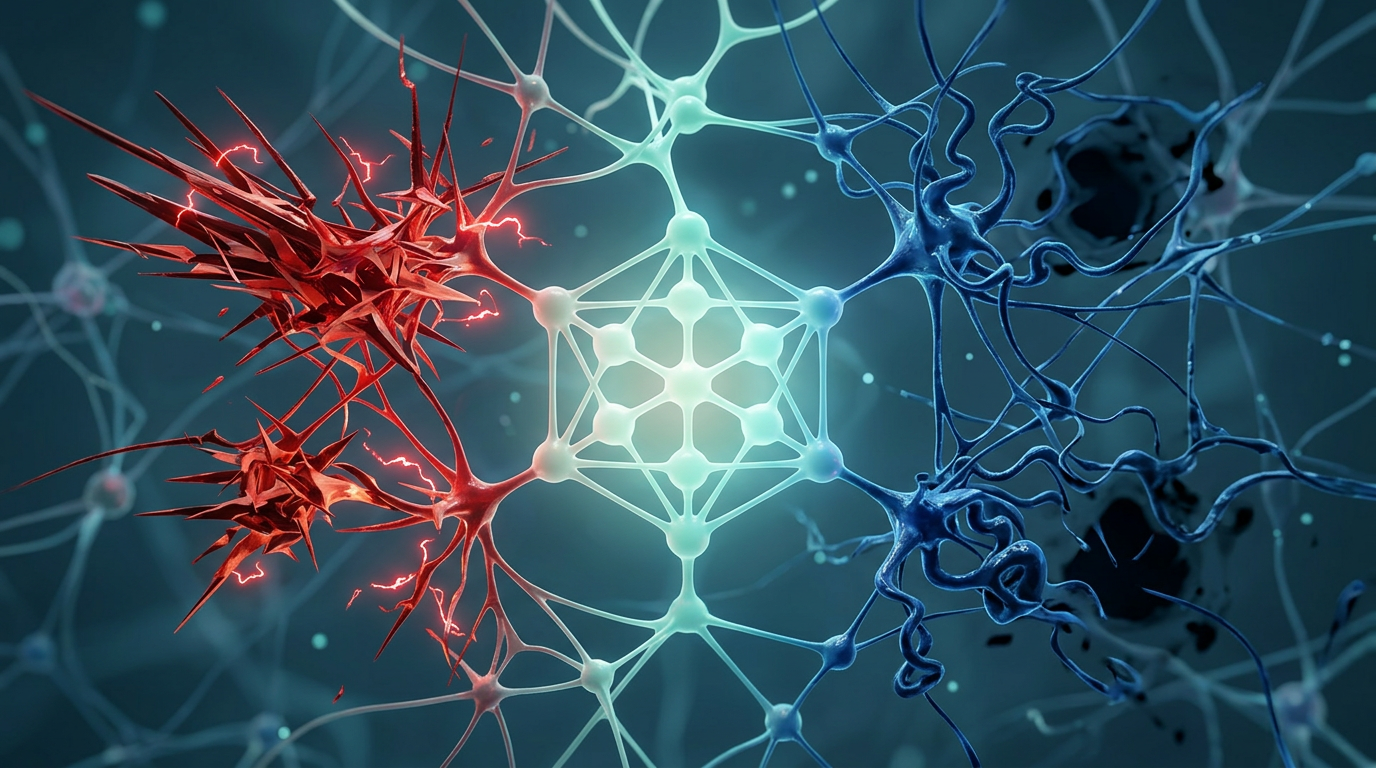
Four steps. One system. Built to decode what the DSM labels, what therapy circles around, and what most advice completely misses, the nervous system underneath the behavior.
The Problem With the Current System
The Diagnostic and Statistical Manual of Mental Disorders is a billing and classification tool. It was designed to help clinicians agree on terminology and insurance companies agree on reimbursement. It was not designed to give you a map of your inner world.
What it does instead is take a cluster of behaviors, behaviors that often make complete sense when you understand the nervous system and attachment history behind them, and attach a label that implies something is wrong with you.
A label without a map is just a name for your suffering. It does not tell you what to do next.
BPD. ADHD. NPD. CPTSD. These are real experiences. The people who carry these labels are real people in real pain. But the label alone does not explain why the pattern exists, what it is protecting, or how to work with it instead of against it.
The Pattern Translation Framework was built as a direct response to this gap. Not to replace clinical care, but to give people the layer underneath the label. The nervous system layer. The meaning layer. The repair layer.
When someone understands that their "emotional dysregulation" is actually a freeze response to a threat their nervous system learned to expect before they were old enough to name it, that changes everything. Not because the label is wrong. Because the label was never the full story.
This system was built by someone who has lived inside families where the labels existed but the understanding did not. Where the diagnosis was given but the map was never provided. That absence is what Unscarred was built to fill.
This is not anti-therapy. This is pro-understanding. The goal is to give you language for what is happening inside you so that any support you seek, therapy, support, or community, can actually land.
The Framework
Every pattern you are stuck in runs through these four layers. The work is learning to read all four, not just the one on the surface.
The signal is the behavior you can see. Shutting down. Exploding. Chasing. Disappearing. Saying yes when you mean no. Picking fights when you want connection. This is where most people stop, arguing about the behavior, trying to change the behavior, shaming the behavior.
The signal is not the problem. The signal is information. It is the nervous system trying to communicate something it does not have words for. Until you learn to read it as data instead of a character flaw, you will keep trying to fix the wrong thing.
Partner goes completely silent after an argument and does not respond for hours
Person sends 12 texts in a row when they feel ignored, then feels shame about it
Every behavior has a meaning underneath it. The meaning is almost never what it looks like on the surface. Silence is rarely indifference. Anger is rarely about what it claims to be about. Withdrawal is rarely rejection. The meaning is the unspoken need, the unprocessed fear, or the survival strategy that learned to work once and never got updated.
This is the translation layer. This is where the work gets real. When you can read the meaning behind a signal, you stop reacting to the behavior and start responding to the person.
Silence = "I am overwhelmed and I learned that disappearing is the only safe option when conflict happens"
Repeated texts = "My nervous system is in panic because silence has historically meant abandonment"
You cannot think your way out of a nervous system state. You cannot logic yourself into calm when your body is in threat response. The nervous system does not care about your intentions. It responds to perceived safety or perceived danger, and it learned what is dangerous from experiences you may not even consciously remember.
This layer asks: what state is the nervous system in right now? Fight, activated, aggressive, defending. Flight, running, avoiding, escaping. Freeze, shutdown, numb, dissociated. Fawn, appeasing, people-pleasing, self-erasing. Each state requires a completely different response. Most advice ignores this entirely.
Freeze / Dorsal Vagal shutdown, the body has gone offline because the threat felt unsurvivable
Sympathetic activation / Fight-Flight, the body is in panic and trying to outrun abandonment
The repair move is not a fix. It is not a cure. It is the one specific action that can interrupt the pattern in this moment, for this nervous system, in this context. It is always small. It is always specific. And it is always aimed at the actual layer, not the surface behavior.
Most advice gives you a generic repair move and calls it a day. "Communicate better." "Take space." "Use I-statements." These are not useless, but they are useless if you do not know which nervous system state you are working with, what the behavior actually means, and what signal you are trying to send. The repair move only works when the first three layers are understood.
Send one text: "I am not gone. I need 2 hours. I will come back." This signals safety without demanding engagement from a shutdown system.
One message: "I notice I am spiraling. I am going to give myself 30 minutes before I send anything else. You are not in trouble." This interrupts the panic loop without suppressing it.
Core Principles
Every framework principle is built on the assumption that your patterns made sense at some point. They were survival strategies, not character defects. Understanding them does not require hating yourself for having them.
Before any behavioral change is possible, the nervous system state has to be identified. A dysregulated nervous system cannot absorb insight. This is why most therapy homework does not stick, it skips this layer entirely.
The behavior is not the problem. The behavior is data. When you stop trying to eliminate the behavior and start trying to read it, you get access to the actual information, and the actual repair.
You did not develop your patterns alone. They were shaped in relationship and they show up in relationship. Understanding them requires looking at the full dynamic, not just your side of it.
The goal is not to never have a conflict or never feel triggered. The goal is to shorten the loop. To repair faster. To recognize the pattern while you are in it and make one different move. That is how change actually happens.
Complex psychology translated into language that lands. No jargon walls. No academic distance. If the explanation does not feel like it is describing your actual life, it is not doing its job.
Fit
Where This Came From
This framework was not designed in a university or a clinical setting. It was built by someone who grew up inside a family where undiagnosed neurodivergence, untreated trauma, and real psychosis were the daily environment.
Pattern tracking was not a professional skill. It was a survival skill. Learning to read what was really happening underneath what was being said. Learning to decode behavior that made no logical sense until you understood the nervous system underneath it.
Years of obsessive study in attachment theory, personality structure, and trauma response followed. Not to get a credential. To find the language for what had already been lived.
The Pattern Translation Framework is what happens when lived experience meets serious study and refuses to let the DSM be the final word on what is possible for people who have been through real things.
Start Here
Take a quiz. Get a result that describes your inner world with more accuracy than most advice ever has. Then decide what to do next.